The Evidence Check
Mechanistic evidence
Copper participates in enzymes and connective-tissue biology; GHK can bind copper and influence cell-signaling models.
Animal evidence
Preclinical wound and tissue-repair models help explain interest but cannot validate anti-aging claims.
Human evidence
Topical cosmetic studies are more relevant than systemic claims, and even those should be read for design and endpoints.
What remains unknown
Systemic use, long-term safety, and broad rejuvenation claims are not established.
What the Evidence Says
Promising
Copper-peptide biology is a real research area with plausible extracellular-matrix relevance.
Established
'Rejuvenation' is not a precise clinical endpoint.
Unknown
Whether any copper peptide changes meaningful aging outcomes remains unproven.
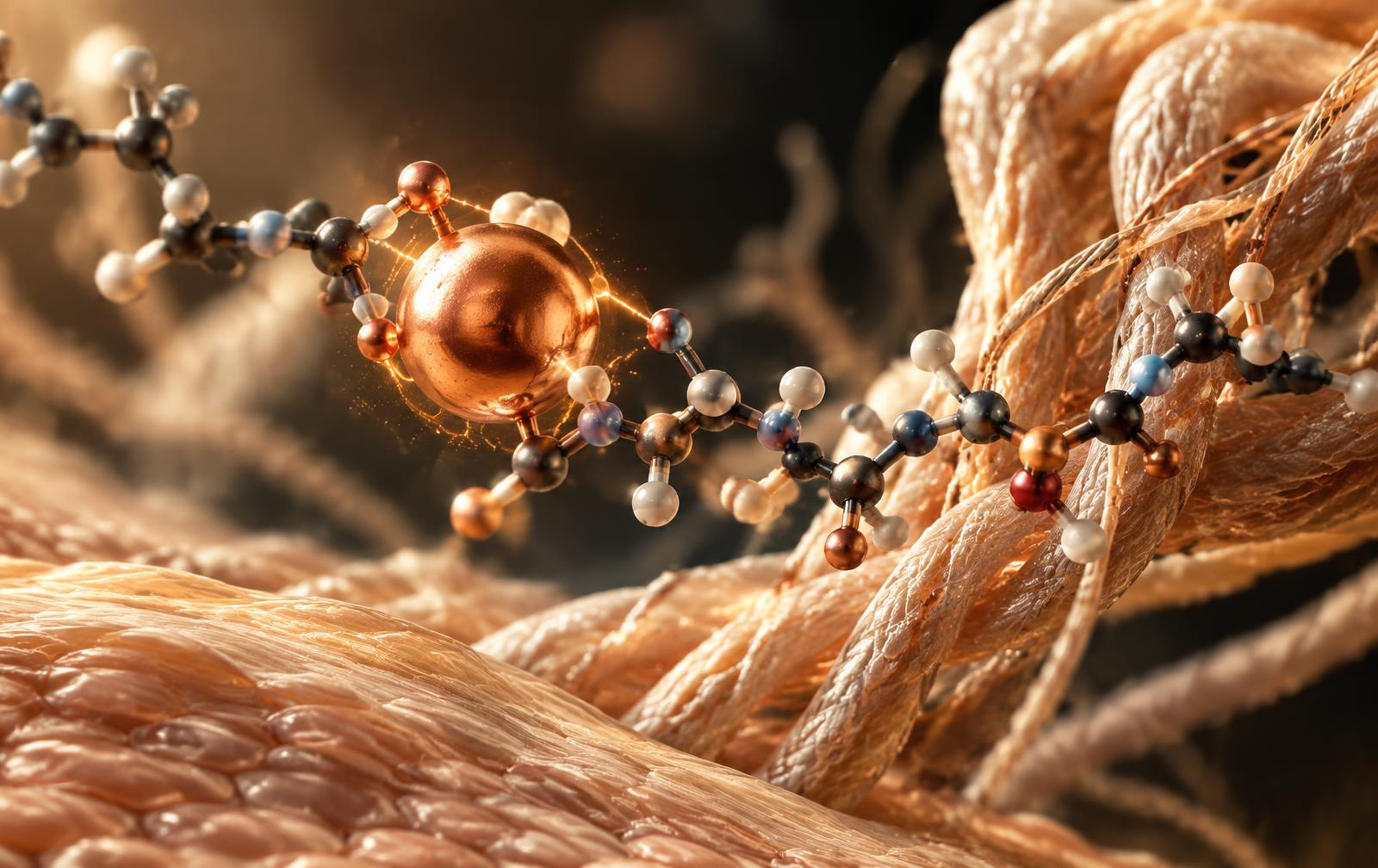
Copper is not just a color cue in skincare marketing. It is a biologically active metal required by enzymes involved in connective tissue, antioxidant defenses, pigmentation, and cellular metabolism. Peptides that bind copper have attracted attention because they sit at the intersection of metal biology and cell signaling.
The best-known example is GHK-Cu, a complex of the tripeptide glycyl-L-histidyl-L-lysine with a copper ion. GHK was identified in human plasma decades ago and has since been studied in relation to extracellular matrix biology, collagen-associated processes, wound models, and gene-expression patterns.[1] That research is why the category is interesting. It is not a license to treat every 'copper peptide' claim as proven.
Why copper matters
Copper-containing enzymes participate in cross-linking collagen and elastin, handling oxidative stress, and maintaining normal cellular function. That makes copper biologically important, but it also makes systemic copper delivery a real safety question. More copper is not automatically better; the body regulates copper tightly because too much or too little can be harmful.
Why peptides matter
Peptides can act as carriers, signals, or structural motifs that change how a metal ion interacts with tissue. GHK-Cu has been studied for effects on fibroblasts, collagen-related pathways, glycosaminoglycan production, and gene-expression signatures. The most responsible interpretation is mechanistic interest plus context-specific evidence, not a global anti-aging verdict.
The word 'rejuvenation'
Rejuvenation is a broad commercial word. It can mean improved skin texture in a topical cosmetic study, accelerated wound closure in an animal model, changes in gene-expression profiles in cultured cells, or nothing measurable at all. A careful reader asks what endpoint was actually measured, in what system, and whether the endpoint matters clinically.
A beautiful mechanism is not the same as a proven human outcome.
Copper peptides deserve attention because the biology is specific. They deserve skepticism because marketing often turns that specificity into claims that the available evidence cannot support.
Sources & Further Reading
The Half-Life Brief
Research worth reading. No hype.
Get evidence-focused breakdowns of peptide research, metabolic health, longevity, performance and emerging science.
Research summaries, not medical advice. Unsubscribe anytime.
Continue the research
Interested in exploring the research platform?
ORA Wellness Labs provides account-based access to its laboratory research-material platform. Half-Life Optimization is editorially independent; nothing in this article is a recommendation, endorsement, or medical advice.
Related research