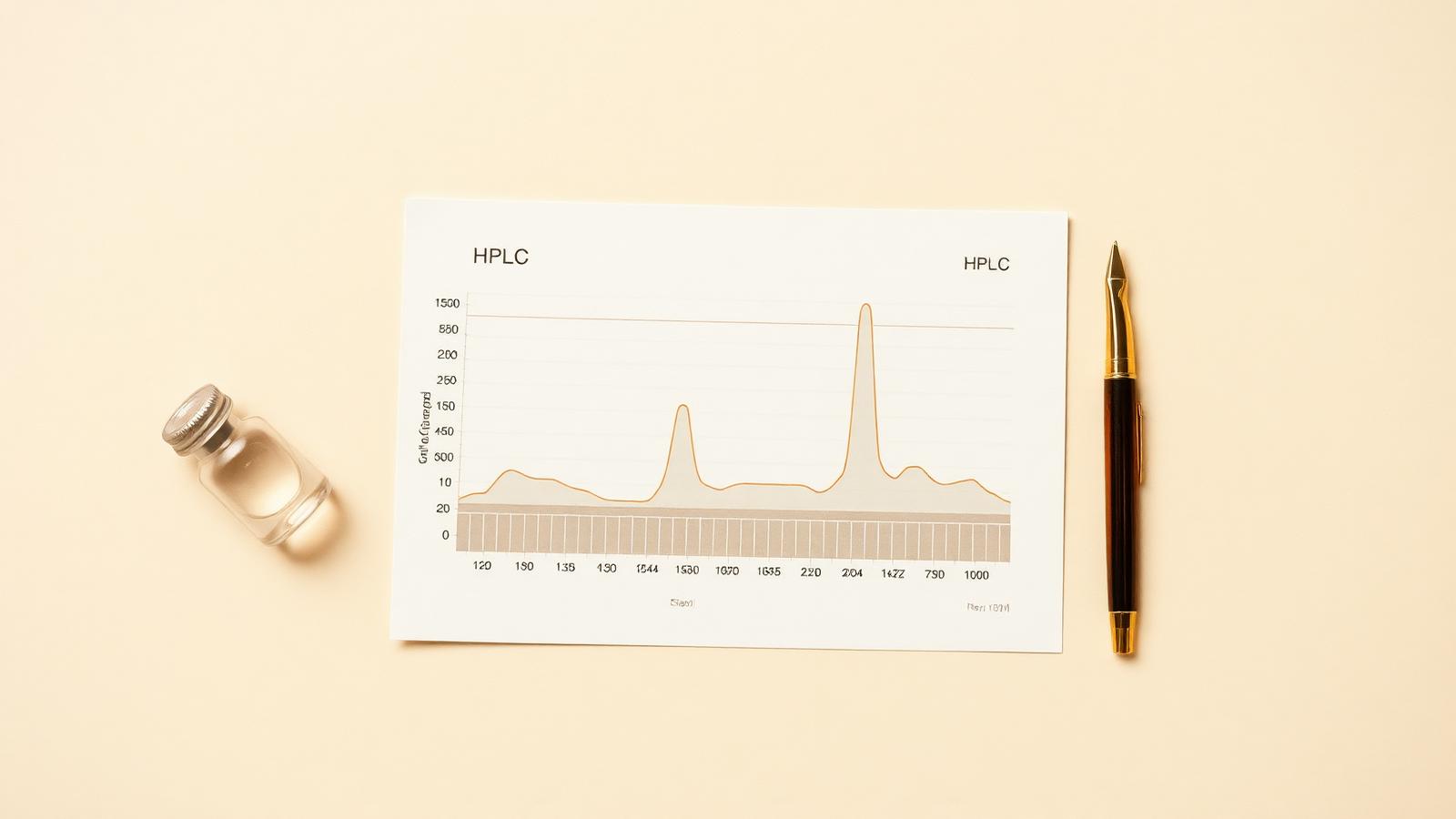
For peptides sold outside the approved-drug supply chain, there is no regulatory body verifying what is in the vial. There is no FDA lot release. There are no state pharmacy-board inspections tied to the specific product a buyer receives. Buyers are asked, instead, to rely on Certificates of Analysis (CoAs) issued either by the seller itself or by a lab the seller contracts with. A CoA is only as good as the test panel behind it and the independence of the lab that ran it.
The four questions a serious CoA should answer
Any Certificate of Analysis worth reading engages, in some form, with four questions. Missing one of them is a meaningful gap; missing several is a red flag.
Identity
Is the molecule in the vial actually the molecule on the label? Identity is typically established by mass spectrometry, which reports the mass of the compound with enough precision to distinguish the target sequence from close analogs. A CoA that reports identity by 'appearance' or 'physical description' is not answering the identity question.
Potency
How much of the labeled molecule is actually present, by mass, in the vial? Potency is typically established by high-performance liquid chromatography (HPLC), which separates the target compound from impurities and integrates the peak area against a reference standard. A potency figure without a defined analytical method behind it is not informative.
Sterility
For a lyophilized (freeze-dried) or liquid product that will be reconstituted and injected, is the product free of microbial contamination at the level required for an injectable? Sterility testing is meaningfully different from, and more demanding than, the microbial testing applied to oral supplements. This is a category of risk that does not exist in the same form for pills and powders taken by mouth.[1]
Endotoxin
Bacterial endotoxin — lipopolysaccharide — is a heat-stable component of the outer membrane of Gram-negative bacteria. It survives filter sterilization and can provoke a strong systemic response when injected, even if the product itself has been rendered sterile. Injectable pharmaceuticals are subject to defined endotoxin limits for exactly this reason. A CoA that omits endotoxin is silent on a specific and well-characterized injection risk.
Independent versus in-house testing
A CoA generated by the seller's own quality lab and a CoA generated by an independent, accredited third-party lab are structurally different documents, even if the numbers on them look similar. The in-house version has an obvious conflict-of-interest structure — the same organization that stands to lose revenue from a failing result is the one deciding whether to publish it. The third-party version does not eliminate all forms of gaming (labs can be selected, lots can be cherry-picked), but it removes the most direct conflict.
The most credible disclosures pair a third-party lab identification (a named lab with an ISO/IEC 17025 accreditation, contact information, and a report number) with the ability to match the report to the physical lot on the vial in a buyer's hand. Absent that traceability, a public CoA — however impressive — cannot be tied to any specific unit of product.
What testing cannot do
Even a full, third-party, lot-linked CoA does not establish that a product is safe or effective for a particular use in a particular person. It establishes that the vial contains what the seller says it contains, at the potency stated, without gross contamination. That is a necessary condition for any meaningful downstream conversation about use. It is not a sufficient one.
Reading a CoA in practice
A practical checklist a reader can carry: Is the lab named and independent? Are all four core tests present (identity, potency, sterility, endotoxin)? Does the report cite specific analytical methods? Is the lot number on the CoA matched to the physical product? Are the acceptance criteria explicit? A 'Yes' on all five is uncommon in the current market and is a meaningful signal about how a seller treats quality.
Sources
Newsletter
The science, in your inbox.
Sourced explainers on peptides and biohacking. No hype, no claims — just the research, parsed. One email a week.
Research summaries, not medical advice. Unsubscribe anytime.